
“Contact sales” is a price
Companies hide their pricing to avoid setting an anchor. The buyer sets one anyway, and it is always their worst guess. Why the pricing page is a brand page, and what to publish.
- Section
- Strategy
- By
- Simon Lodge
- Published
- 4 November 2026
- Reading
- 5 min read
Every company that swaps its B2B pricing for a “Contact sales” button believes it has said nothing. In fact, it has said quite a lot.
TrustRadius asks technology buyers each year what they would change about buying software. Since 2023, the answer has stayed the same. In its 2026 report, 42% put transparent pricing first, while the next answer got 24%.
One buyer in the report put it better than the chart does: “When pricing is hidden, I assume it’s expensive, or it’s negotiable in ways that don’t favor me.”
That is the whole problem in a sentence. A hidden price leaves no blank in the buyer’s head. Instead, they fill it with their worst guess. Then they add a charge for the inconvenience: a form, a discovery call, a script, a week.
The pricing page is the busiest page you don’t design
Nobody treats the pricing page as a showpiece. Yet it is one of the busiest rooms on the site.
HockeyStack studied 31 million visitors across 80 B2B SaaS companies. It found that pricing pages took 16.5% of all site traffic. By contrast, demo pages took 0.91% and case studies took 0.76%.
So the page that most companies hand to whoever owns billing gets over thirteen times the visitors of the demo page. It also gets them at the exact moment a buyer starts deciding whether you are for them. Months go into the homepage, while the pricing page gets a table and a button.
Hiding B2B pricing wins the form and loses the deal
There is a reason the gate survives, and it shows up on the dashboard. In the same study, opaque pricing pages turned more visitors into form fills: 4.6%, against 2.8% for pages with a price. If marketing is measured on leads, hiding the number looks like it works.
Follow those leads further, however, and it stops working. Leads from transparent pricing pages became pipeline at 17.5%. Leads from hidden ones managed 10.3%. That makes the open page about 1.7 times better.
The gate catches more people, but worse ones. It catches the curious, the students and the competitors. It also catches buyers who were always going to balk at the number. Meanwhile, prospects who could have qualified themselves now need a sales call to be turned away by hand.
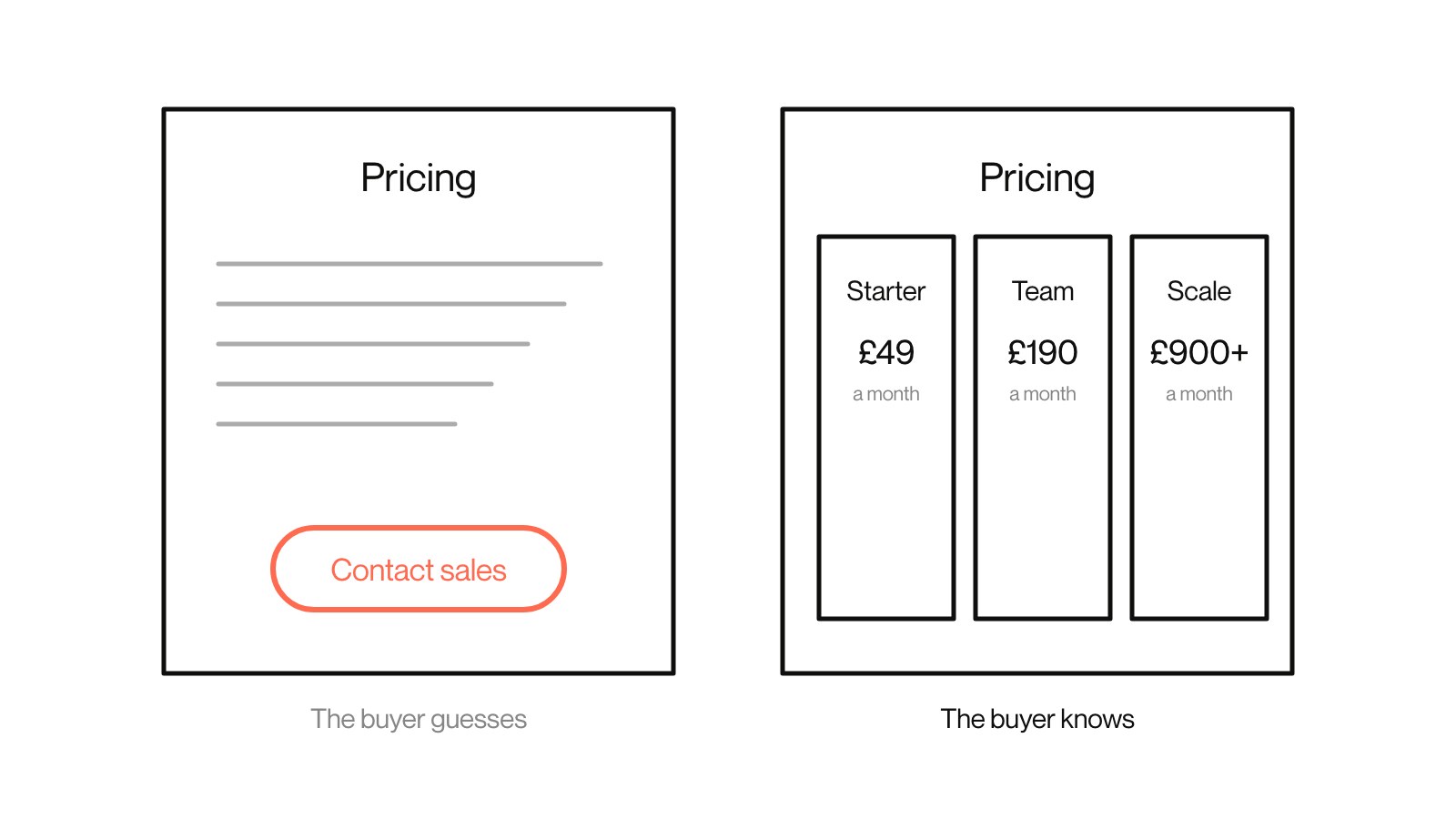
A hidden price doesn’t avoid an anchor. It hands the buyer theirs, and theirs is always the worst case.
It is the same mistake we described in the funnel is a fiction. Teams tune the stage they can measure, at the expense of the decision they can’t see.
The number is part of the brand
Price is a brand signal whether anyone designs it or not. For example, Akshay Rao and Kent Monroe reviewed 36 studies and found a steady link between price and perceived quality. People read the number as a cue for what they are getting. So your price, or the missing one, does positioning work for you.
Openness about money also buys trust. In a field study, Bhavya Mohan, Ryan Buell and Leslie John showed diners a sign with the cafeteria’s costs. As a result, diners were 21% more likely to buy soup (Harvard Business School). They read the sign as candour.
Nobody is suggesting you publish your margins, of course. A café is also a long way from a software contract. Still, the direction of the effect is useful. Being straight about money reads as confidence, while secrecy reads as a reason to be careful.
Buyers are careful already. In Gartner’s 2025 survey, 61% of B2B buyers said they would rather buy with no sales rep at all (Gartner). And 69% had noticed gaps between a supplier’s website and what its sellers said. A website that refuses to say anything hardly helps with that.
“Our pricing is too complex” is usually a choice
The standard defence is that enterprise deals are bespoke. Some are. Even so, look at who publishes anyway.
Salesforce is the company most people picture when they hear “enterprise sales”. Yet it lists its sales product at £20 to £440 per user per month. HubSpot also shows its enterprise marketing tier from $3,600 a month, with the $7,000 onboarding fee next to it.
Atlassian went further. Its then president, Jay Simons, told Intercom in 2019 that cost is “a really common friction point” (Intercom). So the company worked to remove price as a friction point “even at the upper end”.
It doesn’t always hold, and an honest argument says so. Mixpanel made every plan buyable online at one public price in January 2023. About a year later it went back to flexible pricing for its enterprise tier, while keeping the rest public. That is a sensible outcome, and roughly the right shape for most growth companies.
What to publish instead
You don’t need a price for every configuration. Rather than a full list, you need to remove the worst guess.
First, publish a starting price. “From £X a month” tells a buyer whether they are in the right building. It also costs you nothing you weren’t going to say on the first call.
Next, publish the logic. If the price moves with seats, usage or support, say which, and roughly how. That way a buyer can estimate their own number and turn up qualified.
Then give the custom tier a reason, in plain words. “Above 500 users we price on usage, because a flat rate would overcharge most of you” is a brand sentence. A grey button marked “Contact us” is a shrug.
Finally, treat your B2B pricing page as positioning. Write and design it with the care the homepage gets. After all, it is the page your future customers read hardest, at the moment they decide. In most companies, nobody owns it.
Somebody is going to set your price in the buyer’s head. It ought to be you.